


Botryococcus sp. BAA-2026
Chlorophyta › Trebouxiophyceae › Trebouxiales › Botryococcaceae › Botryococcus
Description
History of Receipt and Isolation
- Country of origin: Republic of Kazakhstan.
- Place of isolation: Lake Alakol (saline lake), Abai–Zhetisu region.
- Habitat: brackish–saline lake ecosystem.
- Isolated by: Zayadan B.K., Kabaeva A.E., Dauletova A.A., Bolatkhan K., Sanatov S.S., Askar A. at the Laboratory of Biotechnology, al-Farabi Kazakh National University.
- Year of accession to the collection: 2026.
- Method of obtainment: isolated from an enrichment culture obtained from a natural sample by successive microbiological plating.
- Genetic features: Wild type.
- Culture condition: Axenic.
Morphology and Structure
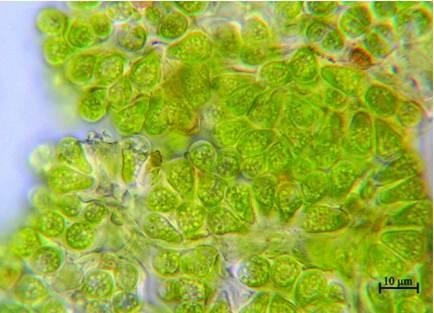
Green colonial microalga consisting of oval or drop-shaped cells. Cell length is 8–13 µm, width is 5–8 µm. On solid nutrient medium, the culture forms light green colonies resembling microscopic grape clusters; colony shape is unstable (lobed or clustered).
Cultivation
- Nutrient Media: BG-11 (liquid and agarized)
- Temperature: 25 ± 2 °C
- Light Intensity: 40–55 µmol photons/m²/s
- Photoperiod: 12:12 h (light/dark)
- pH: 7.0–7.2.
Physiological Characteristics
Mesophilic, photoautotrophic.
Long-term Preservation Conditions
Maintained in liquid BG-11 medium with subculturing every 2–3 months.
Field of Application
Promising for biofuel and valuable chemical production: representatives of the genus Botryococcus (primarily B. braunii) are characterized by the synthesis and accumulation of liquid hydrocarbons, which can be converted via hydrocracking into high-quality gasoline, aviation jet fuel (kerosene), and diesel. It is also a promising raw material source for biodegradable bioplastics.