


Phormidium sp.
Cyanobacteriota › Cyanophyceae › Oscillatoriales › Phormidiaceae › Phormidium
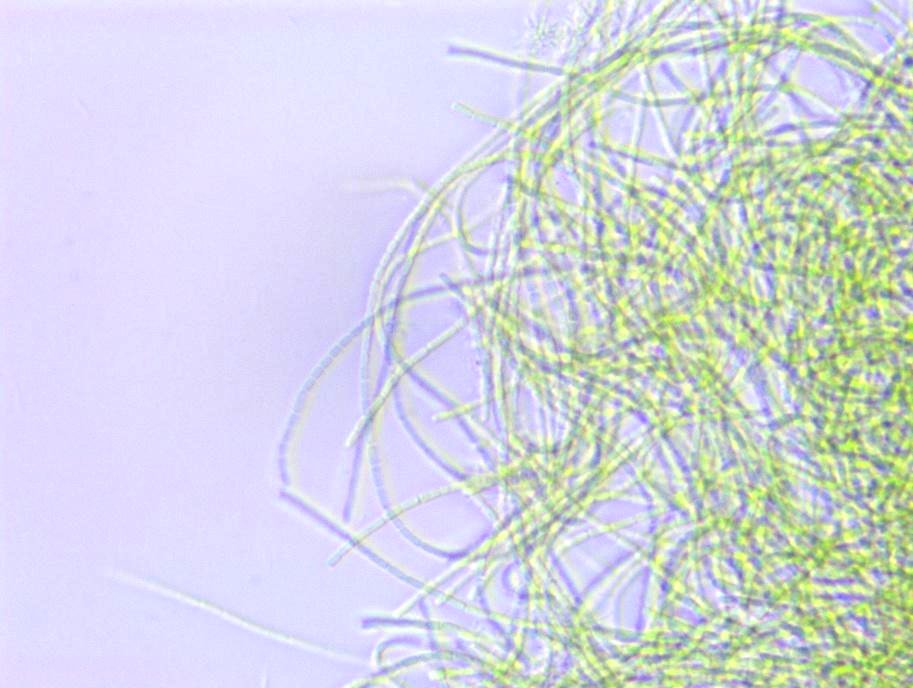
Description
History of Receipt and Isolation
- Country of origin: Republic of Kazakhstan
- Place of isolation: village of Bakanas, Balkhash District, Almaty Region
- Habitat: rice field.
- Isolator(s): researchers of the Research Institute for Biological and Biotechnology Problems at Al-Farabi Kazakh National University, under the supervision of F.K. Sarsekeyeva.
- Year of entry into the collection: 2025.
- Method of obtainment: isolated from an enrichment culture obtained from a natural sample by sequential microbiological streaking
- Genetic features: Wild type (WT)
- Culture state: axenic
Morphology and Structure
A multicellular, filamentous cyanobacterium. Trichomes are unbranched, straight or slightly curved. Cells are cylindrical, closely connected to one another, blue-green in color, and surrounded by a thin mucilaginous sheath. The strain does not form heterocysts or akinetes. Cells are 3.0–6.0 μm in width.
Cultivation
- nutrient media: BG-11, Zarrouk (liquid and agarized)
- temperature: 25 ± 2 °C
- light intensity: 30–40 µmol photons/m²/s
- photoperiod: 16:8 h (light/dark)
- pH: 7.0–7.5.
Physiological Characteristics
Mesophilic, photoautotrophic, filamentous cyanobacterial strain. It exhibits active photosynthetic growth and biomass accumulation. The strain does not form heterocysts and is incapable of atmospheric nitrogen fixation under aerobic conditions.
Long-term Preservation Conditions
maintained on agar-solidified Zarrouk mineral medium at 4–12 °C under low light intensity (10–20 µmol photons/m²/s). Subculturing is performed every 2–3 months. For long-term preservation, cryopreservation at −80 °C or in liquid nitrogen using appropriate cryoprotectants is recommended.
Field of Application
The culture has potential for the production of biofertilizers and plant growth biostimulants, improvement of soil fertility, restoration of degraded agroecosystems, and fundamental research in the physiology, ecology, and biotechnology of cyanobacteria during the implementation of the scientific project AP26101745 "Application of cyanobacterial strains for the production of organic fertilizers and biostimulants in agriculture".