


Anabaena sp.
Cyanobacteria › Cyanophyceae › Nostocales › Nostocaceae › Anabaena
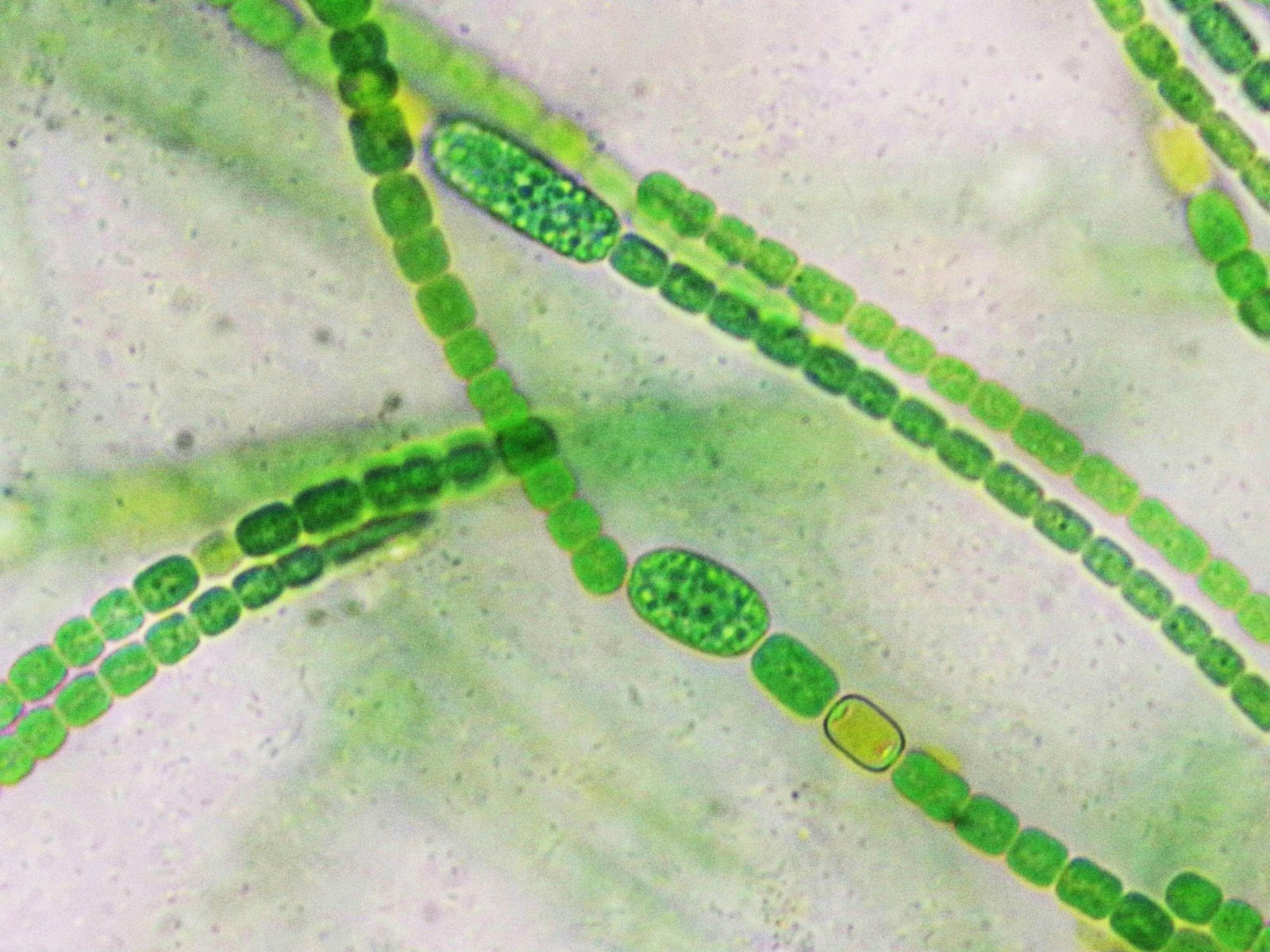
Description
History of Receipt and Isolation
- Country of origin: Republic of Kazakhstan
- Place of isolation: Aktau city, industrial zone of the oil refinery, production facilities, sampling point M-4 located at the outlet of the production units.
- Habitat: Petroleum-contaminated industrial wastewater.
- Isolator(s): B.K. Zayadan, A.A. Dauletova & Bolatkhan K. at the Biotechnology Laboratory of Al-Farabi Kazakh National University
- Year of accession to the collection: 2024.
- Method of obtainment: isolated from an enrichment culture obtained from a natural sample by sequential microbiological streaking onto solid mineral BG-11 medium
- Genetic features: Wild type (WT)
- Culture condition: Axenic.
Morphology and Structure
The culture consists of multicellular unbranched filaments (trichomes). Trichomes are straight, curved, or slightly coiled and occur singly or form loose aggregates. Vegetative cells are barrel-shaped, ellipsoidal, or spherical and are arranged in bead-like chains. The cells contain photosynthetic pigments that impart a blue-green or emerald-green coloration to the culture. Dimensions of vegetative cells: Width: 3.0–5.0 μm; Length: 3.5–6.0 μm.
Cultivation
- culture medium: mineral BG11 medium (liquid and agar-solidified)
- temperature: 25–28 °C
- light intensity: 40–60 µmol photons/m²/s
- light regime: 16:8 h (light/dark)
- pH of the medium: 7.5–8.0.
Physiological Characteristics
Halotolerant.
Long-term Preservation Conditions
maintained as subcultures on liquid and 1.5–2.0% agarized nitrogen-free mineral BG11₀ medium. The storage temperature is +12 to +15 °C. The light intensity is maintained at 5–10 μmol photons/m²/s under a 12 h light/12 h dark photoperiod. Collection cultures are subcultured every 2–3 months.
Genetic Information
GenBank accession number PZ742815
Field of Application
The strain is intended for use in fundamental research and biotechnology.