


Anabaena variabilis K-1
Cyanobacteria › Cyanophyceae › Nostocales › Nostocaceae › Anabaena
Description
History of Receipt and Isolation
- Country of origin: Republic of Kazakhstan.
- Site of isolation: soils of Almaty region
- Habitat: soil.
- Isolator(s): Zayadan B.K., Sadvakasova A.K., in the Biotechnology Laboratory of Al-Farabi Kazakh National University.
- Year of accession to the collection: 2015
- Method of obtainment: isolated from an enrichment culture obtained from a natural sample by sequential microbiological streaking.
- Genetic features: Wild type (WT)
- Strain condition: Axenic.
Morphology and Structure
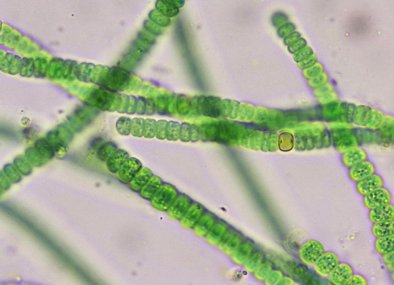
Trichomes are single, short, slightly curved, 2.7–3.4 µm wide. Cells are more or less barrel-shaped, 2.8–4 µm long. Heterocysts are elongated, 3.5–4.5 µm wide, 4–6 µm long. Spores are ellipsoid or ellipsoid-cylindrical, 3.5–5 µm wide, 6–7.5 µm long, with a colorless sheath. Cells are filamentous, of prokaryotic type, blue-green in color, 2–6 µm in size.
Cultivation
- Nutrient medium: BG-11₀ medium (liquid and agar-solidified)
- Temperature: +25 °C
- Light intensity: 50–100 µmol photons/m²/s
- Light regime: 16:8 h (light/dark)
- pH: 7.0–8.0
Physiological Characteristics
mesophile, photoautotroph.
Long-term Preservation Conditions
maintained on liquid and 1.5–2.0% agarized mineral BG-11 medium. Storage temperature: 12–15 °C; light intensity: 5–10 μmol photons/m²/s; photoperiod: 12:12 h (light/dark). Culture subculturing is performed every 3 months.
Deposition Information
certificate of deposition of microorganism in 2015 into the Republican Collection of Microorganisms of the Republic of Kazakhstan. Registration Number: RKM 679
Field of Application
capable of biohydrogen (H₂) production, nitrogen fixation, and use in biotechnological processes. Promising for renewable energy, biohydrogen technologies, and environmentally friendly biotechnological production.