


Tetradesmus obliquus
Chlorophyta › Chlorophyceae › Sphaeropleales › Scenedesmaceae › Tetradesmus
Description
History of Receipt and Isolation
- Country of origin: Republic of Kazakhstan.
- Place of isolation: Aktau, industrial zone of the Oil Refinery, production units, sampling point M-4 (at the outlet of the production units).
- Habitat: Oil-contaminated wastewater.
- Isolator(s): B.K. Zayadan, A.A. Dauletova, B.K. Zayadan and A.A. Dauletova, K.Bolatkhan at the Biotechnology Laboratory of Al-Farabi Kazakh National University
- Year of accession to the collection: 2024.
- Method of obtainment: isolated from an enrichment culture obtained from a natural sample by sequential microbiological streaking
- Genetic features: Wild type (WT)
- Culture condition: Axenic.
Morphology and Structure
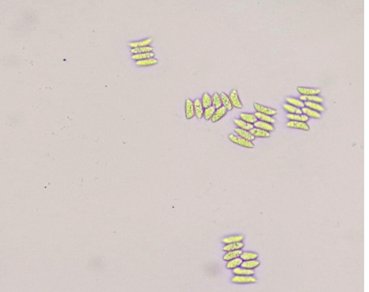
Facultatively coenobial (colonial) or unicellular eukaryotic organism (green microalga). Depending on cultivation conditions, it exists as solitary cells or forms flat coenobia consisting of 2, 4, or 8 (rarely 16) cells arranged in one or two rows and joined by their lateral walls. The cells are fusiform (spindle-shaped) or elongated-elliptical in shape with acute (pointed) ends. Flagella are absent (vegetative cells are non-motile). The cell wall surface is smooth; spines, long needles, teeth, and a distinct mucilaginous sheath are completely absent. Individual cell size: length 6–15 µm, width 2–6 µm. According to the size classification of plankton, the strain belongs to nanoplankton (a group of medium-sized microorganisms within the range of 2 to 20 µm).
Cultivation
- culture medium: BG-11 medium
- temperature: 22–26 °C
- light intensity: 60–150 µmol photons/m²/s
- photoperiod: 16 h light / 8 h darkness
- pH of the medium: 6.8–7.5.
Physiological Characteristics
Halotolerant.
Long-term Preservation Conditions
maintained as a subculture on liquid and 1.5–2.0% agarized mineral BG-11 medium. Storage temperature is +4…+8 °C (for refrigerator storage) or +12…+15 °C, light intensity is minimal (5–10 µmol photons/m²/s), and the photoperiod is 12:12 h (light/dark) or maintained in the dark. Subculturing of the collection culture is performed every 3 months.
Genetic Information
GenBank accession № PZ715244
Field of Application
Utilized in fundamental research and biotechnology.