


Scenedesmus obliquus 1
Chlorophyta › Chlorophyceae › Chlorococcales › Scenedesmaceae › Scenedesmus
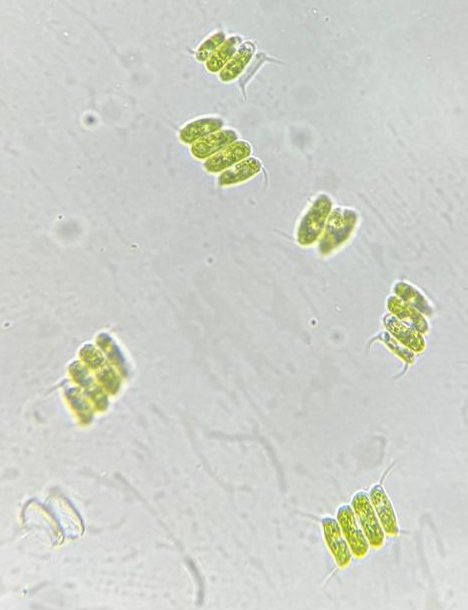
Description
History of Receipt and Isolation
- Country of origin: Republic of Kazakhstan
- Place of isolation: wastewater treatment plants of Almaty
- Habitat: wastewater
- Isolator: Zayadan B.K., Akmukhanova N.R. at the Biotechnology Laboratory of Al-Farabi Kazakh National University.
- Year of accession to the collection: 2001.
- Method of obtainment: Isolated from an enrichment culture obtained from a natural sample by sequential microbiological streaking.
- Genetic features: Wild type (WT)
- Strain condition: axenic
Morphology and Structure
Consists of 2–4-8 cell coenobia, interconnected in a single row by the envelopes of their middle parts. The cells have a distinctly spindle-shaped form with pointed, noticeably inwardly curved ends. The internal structure is characterized by the presence of a single peripheral chromatophore containing one distinct pyrenoid.
Cultivation
- Nutrient Medium: Tamiya medium (liquid and agarized)
- Temperature: 24–28 °C
- Light Intensity: 60–120 µmol photons/m²/s
- Photoperiod: 16:8 h (light/dark)
- pH: 7.0–7.5
Physiological Characteristics
mesophilic, autotrophic. Under optimal cultivation conditions for biomass production (with continuous CO₂ supply), 1.5–2.0 g/L of dry biomass is obtained on days 7–8; protein content – 48–50%, carbohydrates – 40–45%.
Long-term Preservation Conditions
maintained on liquid and 1.5–2.0% agarized Tamiya medium. Storage temperature 10–12 °C, light intensity 10–20 µmol photons/m²/s, photoperiod 12:12 h (light/dark). Subculturing is carried out as needed, but at least once every 2–4 months.
Deposition Information
deposited in 2003 into the Republican Collection of Microorganisms of the Republic of Kazakhstan. Registration Number: A-RKM 0125
Field of Application
in fundamental research and biotechnology.