


Chlamydomonas reinhardtii CC Nfr-4
Chlorophyta › Chlorophyceae › Chlamydomonadales › Chlamydomonadaceae › Chlamydomonas
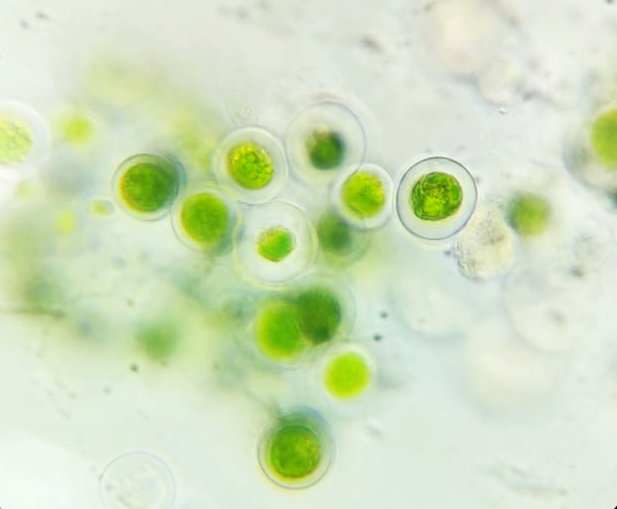
Description
History of Receipt and Isolation
- Country of origin: Russia
- Place of isolation: Culture Collection of Algae at the Laboratory of Microbiology, Biological Research Institute of Saint Petersburg State University, St. Petersburg (CALU)
- Isolator(s): Zayadan B.K.
- Year of accession to the collection: 2001
- Last identification: Zayadan B.K., Akmukhanova N.R., Sadvakasova A.K., at the Biotechnology Laboratory of Al-Farabi Kazakh National University; 2013
- Method of obtainment: mutagenesis (UV-induced + selection for herbicide resistance).
- Genetic features: norflurazon-resistant mutant
- Strain condition: axenic
Morphology and Structure
unicellular; the cell, with a diameter of 8–12 micrometers, is enclosed by a plasma membrane, to which a cell wall adheres externally, and is surrounded by a protective capsule in the form of a transparent mucous layer, often uniting the divided cells into small palmelloid clusters (in pairs and tetrads). The cell contains a single large cup-shaped chloroplast with a granular structure.
Cultivation
- Nutrient Medium: TAP medium (liquid and agarized)
- Temperature: 24–28 °C
- Light Intensity: 50–100 µmol photons/m²/s
- Photoperiod: 16:8 h (light/dark)
- pH: 7.0–7.5
Physiological Characteristics
mesophile, autotroph, exhibits resistance to the herbicide norflurazon.
Long-term Preservation Conditions
maintained on liquid and 1.5–2.0% agarized TAP medium. Storage temperature 10–12 °C, light intensity 10–20 µmol photons/m²/s, photoperiod 12:12 h (light/dark). Subculturing is carried out as needed, but at least once every 2–4 months.
Deposition Information
deposited in 2003 into the Republican Collection of Microorganisms of the Republic of Kazakhstan. Registration Number: A-RKM 0129
Field of Application
in fundamental research and biotechnology.
Bibliography
- Заядан, Б. К., Салимова, Е. Ф., Звинчук, А. Р., & Чунаев, А. С. (1994). Два типа мутантов Chlamydomonas reinhardtii, отобранных по устойчивости к норфлуразону. Генетика, 30, 17–18.
- Заядан, Б. К. Генетический анализ мутантных штаммов Chlamydomonas reinhardtii, устойчивых к норфлуразону / науч. рук. А. С. Чунаев. – Санкт-Петербург, 1996.
- Звинчук, А. Р., Боскетти, А., Чунаев, А. С., & Заядан, Б. К. (1998). Экспрессия ядерных генов, контролирующих устойчивость к ингибитору фитоендесатуразы — норфлуразону у Chlamydomonas reinhardtii. Цитология, 40(1), 30–32.
- Шорабаев, Е. Ж., Саданов, А. Қ., Чунаев, А. С., & Заядан, Б. К. (2001). Изучение действия гербицида норфлуразона на дикие и мутантные штаммы зеленой водоросли Chlamydomonas reinhardtii. Вестник Национальной академии наук Республики Казахстан, (1), 34–39.
- Mijit, G., Zayadan, B. K., Rahman, E., & Chunaev, A. S. (2003). Analysis of dominant-recessive mutated character of Nfr genes of Chlamydomonas reinhardtii and its mutual interaction with the chloroplastic psbA gene. Acta Genetica Sinica, 30(7), 646–652.
- Mijit, G., Zayadan, B. K., & Chunaev, A. S. (2003). Studies on the genetic aftereffect of herbicide norflurazon on the strains of Chlamydomonas reinhardtii. Journal of Xinjiang University (Natural Science Edition), 20(2), 191–194.