


Parachlorella kessleri UZ 1-6
Chlorophyta › Trebouxiophyceae › Chlorellales › Chlorellaceae › Parachlorella
Description
History of Receipt and Isolation
- Country of origin: Uzbekistan (parental strain from the collection of the Institute of Botany, Academy of Sciences of Uzbekistan); Kazakhstan (storage location)
- Place of isolation: Collection of the Institute of Botany, Academy of Sciences of Uzbekistan
- Last determination: Zayadan B.K., Akmukhanova N.R. in the Laboratory of Biotechnology of al-Farabi Kazakh National University, 2015
- Year of accession to the collection: 2001
- Method of obtainment: collection strain, obtained from the collection of the Institute of Botany, Academy of Sciences of Uzbekistan.
- Genetic features: Wild type
- Strain condition: axenic
Morphology and Structure
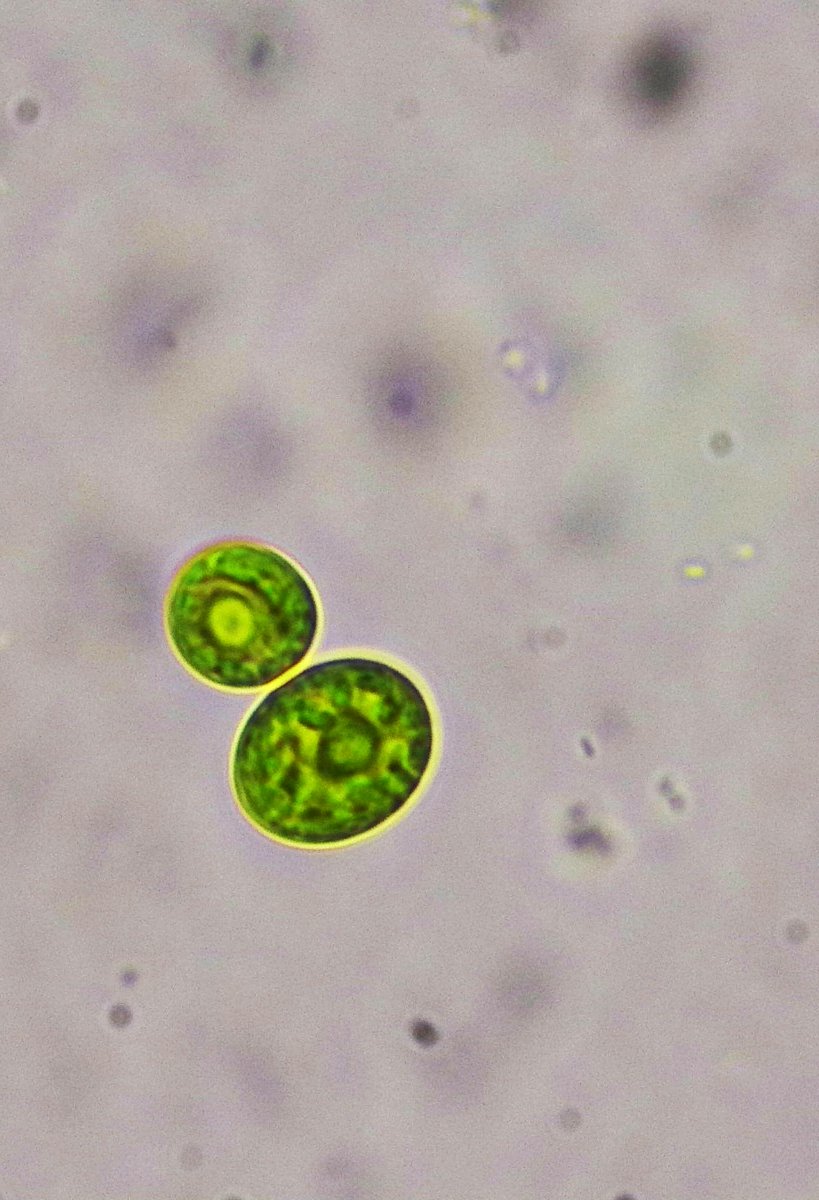
Cells are spherical; the shape of young cells varies from oval or round to polygonal; the cell wall is thin. The chloroplast is granular; in young cells, there is a single lobed chloroplast located peripherally. Pyrenoids, starch, and vacuoles are completely absent or occur only in mature cells; small oil droplets are present. Reproduction occurs by division of the protoplast (resulting in the formation of 4–64 units). Cell diameter is 2.5–17 (3–24) µm; autospores are 2.5–5 µm, young vegetative cells are 5–8 µm, and sporangia are 8–17 µm.
Cultivation
- Culture medium: Tamiya mineral medium (liquid and agarized)
- Temperature: 24–28 °C
- Light intensity: 50–100 µmol photons/m²/s
- Light regime: 16:8 h (light/dark)
- pH of the medium: 6.5
Physiological Characteristics
Mesophile, autotroph. Under optimal cultivation conditions for biomass production (on Tamiya medium at 26–28 °C, pH 6.5, and continuous CO₂ supply), on days 7–8, the content of substances per 1.5–2.0 g/L of dry biomass is: proteins — 48–50%, carbohydrates — 40–45%.
Long-term Preservation Conditions
Stored on liquid and 1.5–2.0 % agarized Tamiya mineral medium. Storage temperature 10–12 °C, light intensity 10–20 µmol photons/m²/s, photoperiod 12:12 h (light/dark). Subculturing is carried out as needed, but at least once every 2–4 months.
Deposition Information
Deposited in 2003 in the Republican Collection of Microorganisms of the Republic of Kazakhstan. Registration number - A-RKM 0119.
Field of Application
In fundamental research and biotechnology.
Bibliography
- Салех М. М., Габалла М. М., Заядан Б. К. и Садвакасова А. К. (2013). Биоремедиация загрязненной воды с использованием диких и мутантных штаммов микроводоросли Parachlorella kesslerii. Экспериментальная биология, 59 (3/1), 168-172.
- Zayadan, B. K., Dyo, Y. M., Userbayeva, A. A., Amangeldy, N. A., Bolatkhan, K., Sarsekeyeva, F. K., & Purton, S. (2015). Study of cell growth and lipid accumulation in cells of newly isolated microalgal strains under cultivation in various conditions. Experimental Biology, 57(1), 34–39.